
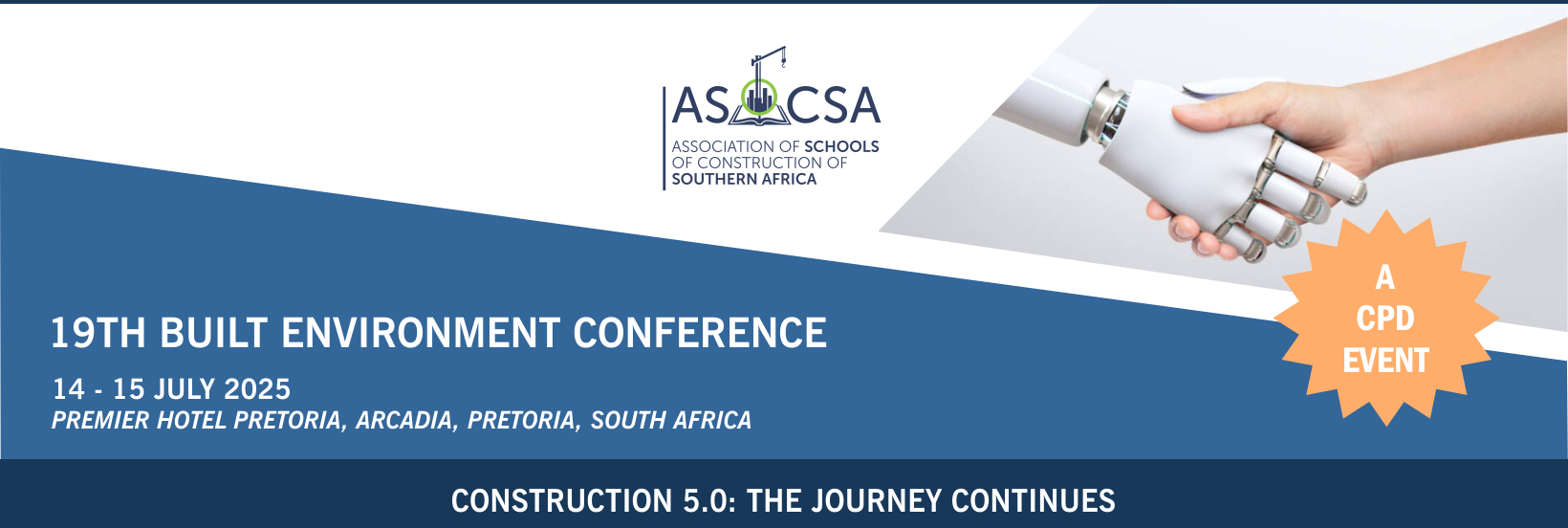
19th Built Environment Conference
CONSTRUCTION 5.0: THE JOURNEY CONTINUES
14 – 15 JULY 2025
PREMIER HOTEL PRETORIA, ARCADIA, PRETORIA, SOUTH AFRICA
The conference organizers recognize that Construction 5.0 is an emerging field of study and implementation. To date not many papers have been published on the subject. Given this reality ASOCSA intended to be the leader in advancing research in C5.0 by adding through its events and proceedings to the growing body of knowledge.
However, it is also true that because of the novelty of the conference theme not many topics on the subject might be submitted. As a compromise the organizers will accept papers that are of a more generic nature provided they are of the highest quality and comply strictly with the superscripted intext numbered form of referencing.
While all accepted papers will be included in the conference proceedings only papers that conform to the conference theme of Construction 5.0 will be invited to submit modified version to a post-conference special issue of the Journal of Construction which is on the DHET’s list of journals approved for subsidy and a post-conference collation of the best chapters in an edited book.
Sub-Themes:
- Innovative use of technology
- Sustainable construction and environment
- Construction industry transformation and development
- Sustainable infrastructure design and delivery challenges
- Procurement innovation and transformation
- Smart Cities and sustainable human settlements
- Innovative waste management
- Public Sector procurement and contracting
- Legislative and regulatory challenges
- Labor challenges and issues
- Transformative education, training and skills development
- Construction health and safety innovation
- SME development
- Women in construction
- Government role in transformation and sustainability
- Project Management in Construction
- Skills Development
- Workforce diversity
ABOUT CONSTRUCTION 5.0
Construction 5.0 (C5.0) represents the next stage in global construction advancement presenting an exciting vision for the future of construction characterized by high efficiency, health and safety, sustainability, and a human-centric focus, where technology complements human skills rather than replacing them. C5.0 will involve up-skilling and re-skilling of the construction workforce to work with new technologies, incorporate the human element into all construction processes, improve working conditions, and foster a culture of creativity and innovation. To be successful, C5.0 must be tailored to the demands of the workers and the industry.
C5.0 is linked to the UN’s 17 Sustainable Development Goals (SDGs) for 2030. As such, activities within the industry must be geared towards sustainability and the optimized use of natural resources. C5.0 potentially accelerates both the green and digital transitions, aimed at a more resilient and sustainable society and economy. It prioritizes human- centric design, enhances human-machine collaboration, demands safer and more inclusive construction work spaces, promotes a greener economy, and fuels societal transformation. It emphasizes that people and the environment are significant and deserve protection and places both at the heart of all construction processes throughout all the construction project phases.
It is argued that if executed properly and proficiently, the construction sector will benefit from:
- Increased profitability and efficiency by optimizing resource allocation, reducing expenditures, and enhancing time effectiveness and management, resulting in increased margins and improved organizational productivity;
- Environmental sustainability and compliance by highlighting waste minimization and environmental
preservation, bringing the construction industry in line with evolving sustainability rules and endorsing responsible practices; - Customization and competitive advantage through people-centered technological progress;
- Adaptability to market dynamics by reinforcing the importance of swift adaptability, flexibility, and responsiveness to shifting market conditions, economic elements, and unexpected occurrences such as the recent global COVID-19 pandemic.
The shift to C5.0 becomes more critical as the construction industry becomes increasingly focused on sustainability with pressure to respond to the challenges of climate change, the depletion of natural resources, and the human impact on natural habitats. The sustainability of construction processes is becoming increasingly important with industry stakeholders having to reduce the environmental impact of the construction industry.
C5.0 promises that construction sites will be ‘smart’, powered by the Internet of Things (IoT). For example, sensors embedded in equipment, materials, and the built environment will continuously gather data, providing real-time insights into project progress, resource utilization, and health and safety conditions. Building Information Modeling (BIM) and digital twins will become commonplace, enabling simulation, optimization, and predictive maintenance.
Artificial Intelligence (AI) and Machine Learning (ML) will be integral in construction decision-making processes which include identification of the best sites for construction, detection of potential design flaws, prediction of project delays or cost overruns, powering predictive maintenance, and consequently significantly enhance efficiency and reduce risks.
Robotics will play a crucial role in performing complex, repetitive, or hazardous tasks, improving productivity, and health and safety, with the synergy between humans and robots becoming more prominent. Robots will augment human capabilities and learn from human experience and expertise.
The conference builds on the previous theme Construction 5.0: Towards a collaborative and people-centered construction industry and continues to seek responses to questions related to current conversations, debates, and empirical research on the challenges of and opportunities presented by C5.0.

WHAT IS C5.0

CALL FOR PAPERS

FEES & RULES

PAPER GUIDELINES

PAPER SUBMISSION